

Most people try to eradicate this herb when they find it in their yard. Once again I am not one of those people. I love it’s strong herbaceous scent when I cut it in the yard and hang it in bundles in my pantry.
THE DISCLAIMER: The following is not to be considered “Medical Advice”. The author is not a “Medical Doctor” or “Health Care Professional”. Any use of this information is solely the responsibility of the Reader. (Words in quotations are legal words used by the US Federal Government.) Caution, pregnant woman should not ingest yarrow.
Yarrow also called Soldier’s Woundwort due to its styptic qualities to staunch wound bleeding, can be an invasive plant if you don’t control it. It grows to three feet tall and spreads underground by rhizomes. It’s botanical name Achillea millefolium is derived from Achilles, the ancient Greek warrior. Legends report that he carried yarrow to staunch soldier’s wounds during the Trojan War. The word millefolium describes the many/million fernlike leaves or foliage. Yarrow is found almost every country. It truly is a worldwide herb. To my knowledge the only part of the yarrow plant not used are the roots/rhizomes.
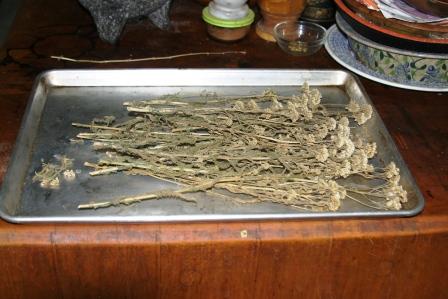
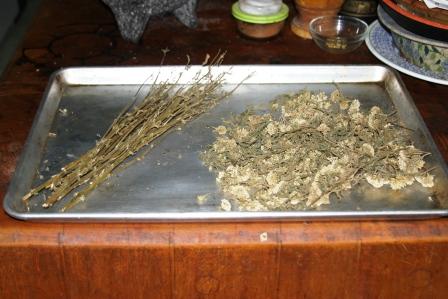
Every year I gather yarrow to hang and dry in my pantry and living room. When I’m ready to process the dried flowers and foliage, I strip them from the thicker stalks. Then I chop/grind the flowers and leaves in a food processor. I don’t use a blender for this step because I can control the fineness of the grind with the food processor. The chopped and cut flower/ leaf mixture is good to make teas and tinctures while a finer ground powder can be used for a poultice for wounds or bruises. A freshly masticated flower/leaf mixture can also be used effectively as a poultice if you don’t have the dried herb mixture. I use the stalks as kindling for starting fires in my fire pit.
The following recipe, Grandma’s Magic Healing Salve, is from “The Wild and Weedy Apothecary” by Doreen Shababy and I am in the process of making it now.
- 3 cups chopped, shredded or torn herb leaves or flowers.
- 3 cups olive oil or almond oil (you may need more to cover the herbs)
- 1-2 ounces of grated or pellets of beeswax
Combine the herbs and oil in a small slow cooker on low heat for 12 hours or overnight until the oil is a dark green color.
Line a strainer with cheesecloth and strain into a small sauce pan. Squeeze out as much oil as you can from the plant material.
Put the saucepan with the oil extract over low heat and add the grated or pellet beeswax.
Once the wax is dissolved put a teaspoon of the mixture onto a plate and allow to cool. Check for texture and hardness. Add more beeswax to the saucepan if needed.
Pour the oil/wax mixture into small jars. Half pint wide mouth canning jars are excellent to use for the salve. Makes approximately 3 cups.
Herbs I used in the oil include:
- Yarrow flowers and foliage
- Plantain leaf
- Chickweed
- Birch tree leaves
- sage leaves
- mint leaves
- lemon balm leaves
- comfrey (I’ll use in the future since I don’t have this in my garden yet)
References:
Identifying and Harvesting Edible and Medicinal Plants By Steve Brill with Evelyn Dean
The Illustrated Book of Herbs by Gilda Daisley
Grow Your Own Herbal Remedies by Maria Noel Groves
The Homesteader’s Herbal Companion by Amy K. Fewll
The Complete Medicinal Herbal by Peoelope Ody
The Wild and Weedy Apothecary by Doreen Shababy

 reddirtcooking